

Restoring Historic Tree Species
VMN volunteers in two chapters are helping restore historic tree species to their native ranges in Virginia. Each shares the story of their project and reflects on how these trees will be enjoyed by future generations.
Twenty Thousand Longleafs Under the Stars
Contributed by Tracy Matthew Melton, VMN Historic Rivers Chapter
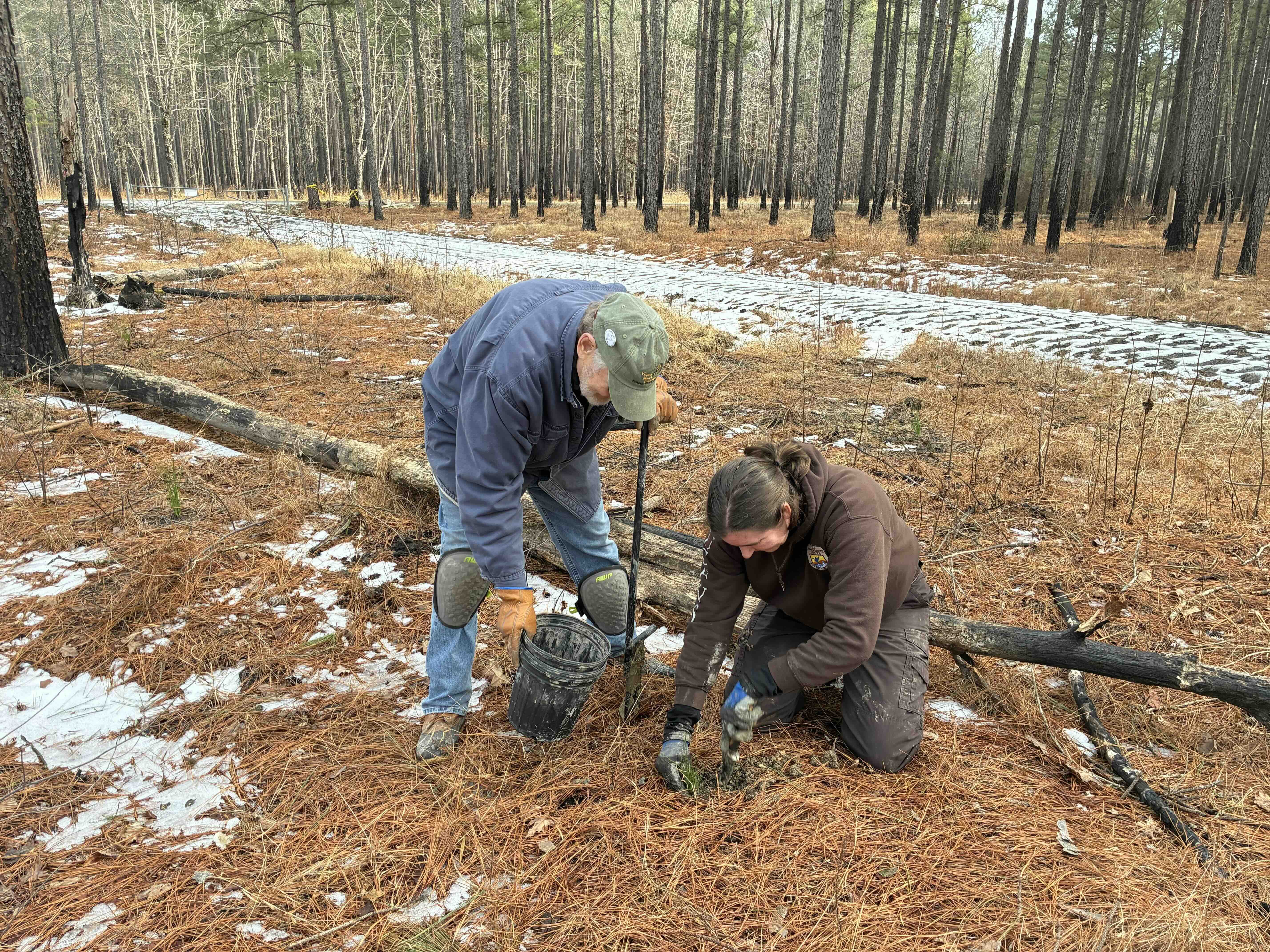
A Historic Rivers Chapter (HRC) volunteer effort with perhaps the most long-lasting impact on our landscape is participation in the planting of 20,000 longleaf pines in the James River National Wildlife Refuge (JRNWR). Some of these trees may stand for more than four centuries!
Cyrus Brame, a wildlife refuge specialist with the US Fish & Wildlife Service (USFWS), leads this landmark project, restoring a small section of the northern range of the decimated longleaf pine and grassland ecosystem. This ecosystem once stretched 94 million acres along the southeastern coastal plain from Virginia to Florida and Texas. Over most of the last decade, HRC volunteers have worked with USFWS employees and other dedicated volunteers to plant 20,000 longleaf pine seedlings. These newly reestablished pine savannas will increase biological diversity and create healthier, more resilient forests.
Over the winter months, USFWS employees and dozens of volunteers put 2000 longleaf seedlings in the ground in the JRNWR. HRC master naturalist Jim Leech had the honor of helping to plant the 20,000th seedling. Other chapter members participating in this most recent phase of the project include Rick Brown, Robert Ambrose, Dan Foster, Pat Lytton, Mike Whitfield, and Dave Watt. Several thousand more longleaf pine seedlings are scheduled for planting at the wildlife refuge in the upcoming season.
Four hundred years. Think of the changes in Virginia since 1626. Some of these trees may be standing in 2426. Hands and shovels in the earth on cold days now. A future barely imaginable. But one given a healthier start.
New Chestnuts for Madison County
Contributed by Alan Edmunds, Chapter President, VMN Old Rag Chapter
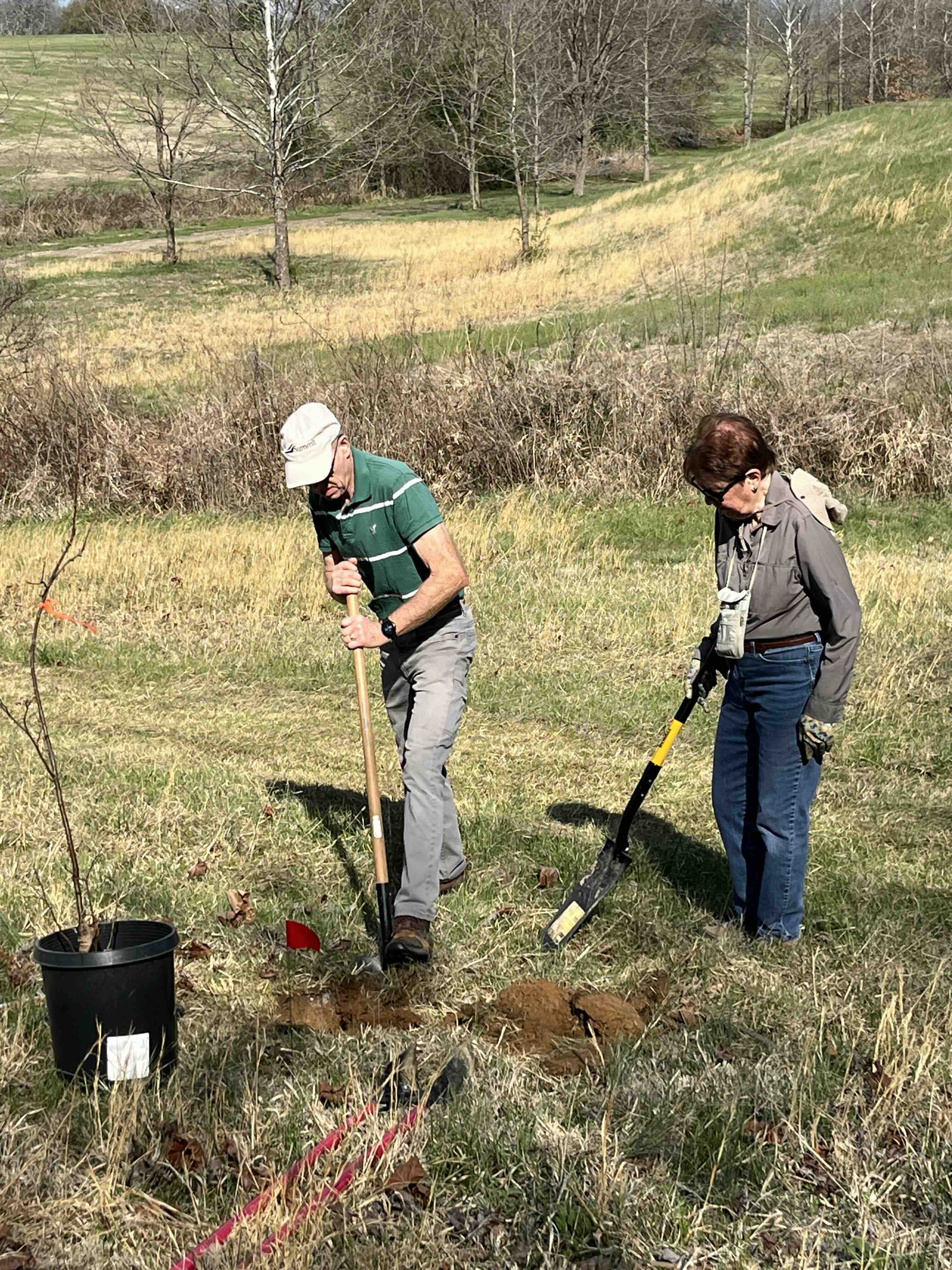
April 1st was a warm spring day in Madison Virginia. Cars and trucks began to arrive at Hoover Ridge Park’s parking lot with Old Rag Master Naturalist (ORMN) volunteers and Department of Forestry employees. It was planting day and the beginning of our effort to help restore the American Chestnuts trees to our community.
The Roots of the Project
While our chapter was actively supporting The American Chestnut Foundation’s (TACF) work on chestnut propagation, we wanted to be more involved in restoration. So, about a year ago, we began our journey to reintroduce chestnut trees to our region.
To spark interest, we reached out to TACF in search of a speaker for one of our membership meetings. Cassie Stark, Director of Science Implementation from The American Chestnut Foundation, gave an amazing talk on the history of the chestnut trees, the blight, and the efforts to create a blight resistant tree. She informed us that TACF has developed an amazing hybrid chestnut that retains the majority of the American Chestnut characteristics but also has some genetics from Chinese Chestnuts, making them far more resistant to the blight.
Excited by Cassi’s presentation, we decided to expand our Stewardship program to help reestablish chestnuts across the six counties our group supports.
Finding a Project Site
We planned to contact county parks in our region, asking if they would be willing to host a chestnut grove. The plantings would give the parks a unique habitat and provide them with educational opportunities to talk about what happened to the chestnut trees and the efforts to bring them back.
The first park we reached out to was Hoover Ridge Park, located in Madison County. We met with Jerry Carpenter, the Parks and Recreation Director and Lindsay Von Herbulis, CPRP, CPSI, CYSA Recreation Coordinator of the park. They were both excited about the prospect of hosting a chestnut tree installation. They agreed to let us create our first chestnut grove at Hoover Ridge Park.
Project Implementation
The first step was to review what we would need for the planting. We applied for a mini-grant from the VMN State Office to buy the necessary material. We were delighted when they agreed to provide us with the funds!
With the grant money, we acquired fencing, stakes, topsoil, weed guard, zip ties, and other necessary materials. One of our members donated tree tubes. The American Chestnut Foundation generously provide us with 4 one-year-old trees and 12 saplings for free.
Before planting, we marked the exact location where we would plant each tree in the park with a red flag. Two days before planting, Alan Edmunds, drove to the Augusta Nursery to pick up the trees and saplings. Then, on April 1st, 2026, the team arrived at Hoover Ridge to help. Eight ORMN team members showed up with shovels, post hole diggers and plenty of energy and enthusiasm. The Department of Forestry came with tools, a truck and buckets of water. The staff at Hoover Ridge Park arrived with digging tools and a front loader of mulch.
Each team dug a hole 1.5 bigger than the root ball of the trees. After checking that the trees would be at the right height, we then covered the roots with a mixture of the removed soil and topsoil. Once the trees were in place, we lay weed guard around the base of the trees and applied mulch. To protect them from deer, we placed tree tubes over the saplings and wire fencing around the bigger trees. Finally, we watered the trees.
Looking to the Future
Now, we must wait and see how our first chestnut grove does, and start work on the next one. They say that when you plant a tree it is really for the future generations to enjoy! We hope someday that today’s kids will be able to walk with their own children under the shade of these chestnut trees and be inspired by our efforts to bring back these iconic trees.